- Home
- Is my roof asbestos?
Is my roof asbestos? How to tell without touching it, and the pre-2008 rule
If the fibre-cement roof was installed before 2008, treat it as asbestos until a test says otherwise. Before 1985, it almost certainly is. Here is how to read the roof from the ground.
Estimate your roof
House roofs run 120 to 180 m². Warehouses start around 500 m².
- Strip only
- R22,500 – R37,500
- Strip + new roof
- R97,500 – R142,500
WhatsApp. Reply in minutes during business hours. Or show us the roof from above.
South Africa banned the manufacture, import and sale of asbestos products on 28 March 2008. Everite, the country's main sheet maker, had already moved its roofing to non-asbestos Nutec after 1985, but imported and stockpiled asbestos-cement kept going onto roofs for years. So: installed before 2008, assume asbestos; before 1985, almost certainly asbestos. The only certain answer is a laboratory test on a sample taken by a competent person.
Six cues, in the order a contractor checks them
- Age of the building. Built or roofed before 1985: almost certainly. Before 2008: possibly. After 2008: no.
- Profile. Asbestos-cement was sold as "Big Six" (a deep corrugation about 146 mm crest to crest) and as standard 6 mm corrugated sheet. Modern Nutec comes in the same profiles, so profile alone does not settle it.
- Surface. Old asbestos-cement is a dull mid-grey, often mottled, with a slightly dimpled underside. Weathered sheets show fine surface fibres, lichen and moss.
- Stamps. Look at the underside from inside the roof space. Non-asbestos sheets are usually embossed "Nutec" or with a code starting "NT". Asbestos-era sheets carry "Everite", "Big Six" or nothing. Stamps wear off, so absence proves little.
- Condition. Brittle edges, cracked corners at the fixings, bitumen patches. Asbestos-cement gets more brittle with every decade.
- The rest of the building. Asbestos gutters, downpipes, fascias and flat ceiling boards from the same era usually mean the roof matches.
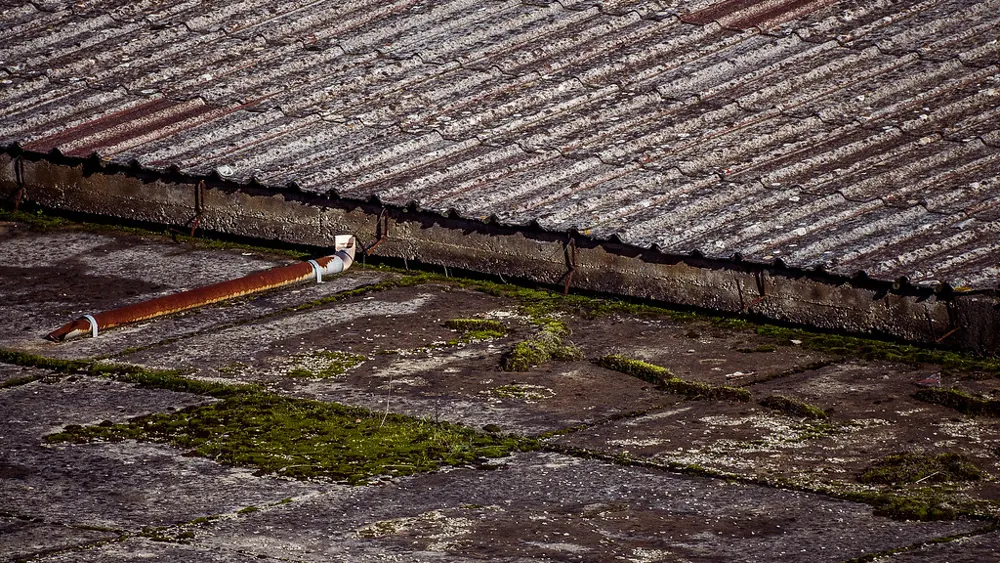 Photo: angelo0690, CC BY-SA 2.0
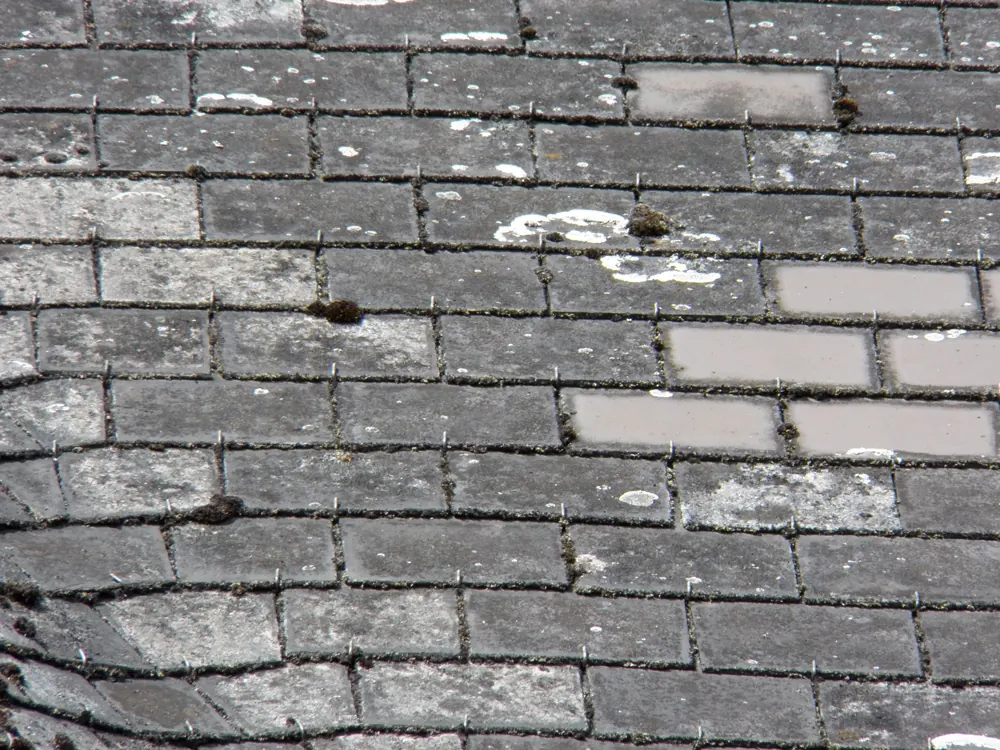 Photo: Amiant, CC BY-SA 4.0
Four tests you must not do
Do not break off a piece
Snapping a corner releases fibres at your face. It is the single most common way homeowners expose themselves.
Do not scrape or sand
Same problem, more dust. Surface preparation of any kind is Type 3 asbestos work.
Do not hold a lighter to it
The "burn test" people describe online creates airborne fibre and proves nothing a laboratory would accept.
Do not pressure-clean or drill
Both are prohibited on asbestos roofs, and both are how installers and cleaners get exposed.
What asbestos does to lungs
Asbestos-cement is safe to live under while the sheets are whole. The fibre becomes dangerous when it is airborne: drilled, ground, pressure-cleaned, broken, or breathed in as dust during a careless removal. The illnesses take decades to show and none of them has a cure.
Mesothelioma
A cancer of the lining of the lungs or abdomen, caused almost only by asbestos. Typically 20 to 40 years after exposure. Not treatable once established.
Lung cancer
Asbestos causes cancer of the lung, larynx and ovaries. Smoking multiplies the risk many times over; the two together are far worse than either alone.
Asbestosis
Scarring of the lung tissue from years of fibre exposure. Shortness of breath that gets worse, then heart and lung failure. Usual onset 10 to 40 years after exposure.
No safe level
The WHO treats all six forms of asbestos, including the chrysotile in South African roof sheets, as carcinogenic. The limit for workers here is 0.1 fibres per millilitre of air.
Source: World Health Organization asbestos fact sheet; South African Asbestos Abatement Regulations, 2020 (occupational exposure limit). This is general information, not medical advice; anyone with past exposure and symptoms should see a doctor.
How to confirm it
Send a photo
A clear picture of the roof, the underside if you can see it, and the building’s age gets you a registered contractor’s read on WhatsApp within the day. Free.
Competent person survey
For a business, the 2020 regulations require the inventory to be done by a competent person. They sample and document every asbestos item, not only the roof.
Laboratory analysis
A sealed sample examined under polarised light microscopy by an accredited laboratory. The only result an inspector, insurer or buyer’s attorney accepts as proof.
What about asbestos tiles and slates?
Asbestos-cement was also pressed into flat slates and diamond-pattern tiles, common on 1950s to 1970s houses, churches and schools. They are thin (about 5 to 6 mm), grey to blue-grey, and snap cleanly. Concrete tiles are much thicker and heavier; clay tiles are red or brown and ring when tapped. Thin grey slates on a pre-1985 building: treat as asbestos.
If it is asbestos, what now?
Nothing has to happen today if the roof is intact. Leave it alone, let nobody drill it, and if the building has staff, get it into the inventory. When solar, a sale or a leak forces the issue, the cost page has the numbers and the process page shows what a compliant removal looks like.
Questions people ask about identifying asbestos roofs
Does grey corrugated roofing always mean asbestos?
No. Modern Nutec fibre-cement is sold in the same Big Six and corrugated profiles and is also grey. The difference is the date and the stamp: a Nutec or NT marking means non-asbestos; a pre-1985 building with unmarked grey sheets means asbestos-cement.
Can I tell from a photo?
Usually to the level of "very likely" or "unlikely", not to certainty. A clear photo of the roof, the underside and the building age lets a registered contractor say which way it leans. A laboratory test on a sample is the only proof.
Is there a home test kit for asbestos?
Not one an inspector or insurer will accept. Confirmation is a sample taken by a competent person and analysed by an accredited laboratory using polarised light microscopy. Breaking off a piece yourself releases fibres and is the one thing not to do.
My house was built in 1998. Could the roof still be asbestos?
Possibly. Everite stopped making asbestos sheets after 1985 but imported and stockpiled asbestos-cement was still installed until the 2008 ban. Check the underside for a Nutec or NT stamp; without one on a 1990s house, have it looked at.
Are asbestos ceiling boards and gutters the same problem?
Yes. Flat asbestos-cement ceiling boards, gutters, downpipes and fascias from the same era are asbestos too, and they are often missed in a roof-only quote. A compliant removal lists them as separate lines.
Not sure? Send a photo
A picture of the roof, the underside if you can see it, and the year the house was built. A registered contractor tells you what it most likely is, free.